

“Why am I not losing weight in a calorie deficit?” It’s one of the most common, and most frustrating, questions in weight loss, and the short answer is: if you’re in a calorie deficit and the scale isn’t moving, the most common causes are an underestimated deficit (tracking errors), water retention masking fat loss, muscle gain offsetting fat loss, a slowed metabolism from long-term dieting, hormonal or medical factors, poor sleep and stress, and simply not giving it enough time. Below, we break down each one and what actually helps when the diet alone has stalled.
If you’ve been counting calories, cutting portions, and still not seeing results after weeks, you’re not imagining it, and you’re not “doing it wrong” in some vague sense. There are usually one or two specific, fixable reasons. This guide walks through the real ones, in order of how often we see them at our clinic in Oldham.
Quick Answer Table
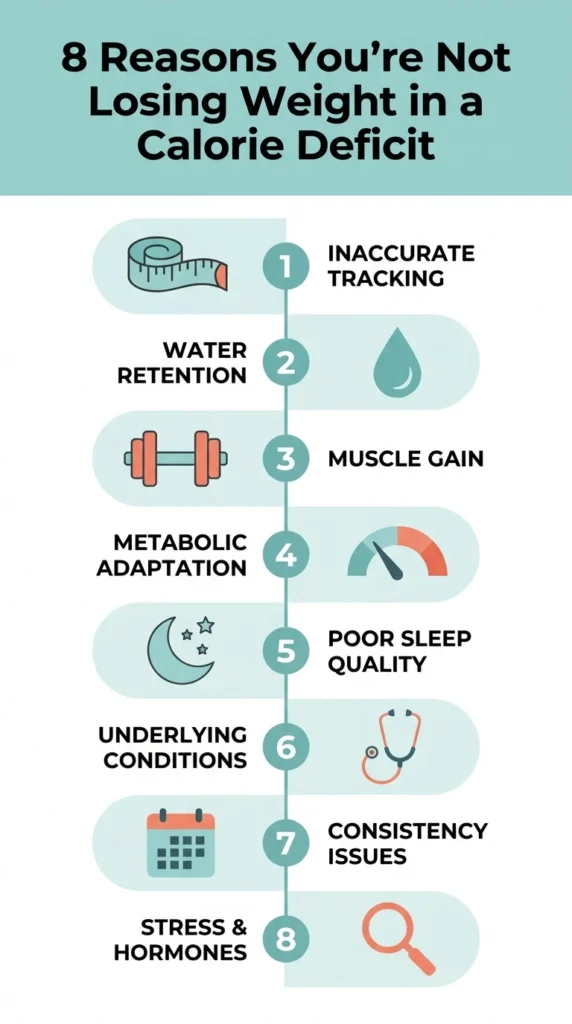
| Reason | How Common | Fixable In |
|---|---|---|
| Tracking errors (bigger deficit gap than you think) | Very common | 1–2 weeks |
| Water retention (sodium, stress, hormones, new training) | Very common | 1–3 weeks |
| Muscle gain alongside fat loss | Common (esp. if lifting) | Ongoing |
| Metabolic adaptation from prolonged dieting | Common after 8+ weeks | 1–2 refeed weeks |
| Poor sleep and chronic stress (raised cortisol) | Common | 2–4 weeks |
| Underlying hormonal/medical factors (thyroid, PCOS, menopause) | Less common but real | Needs GP input |
| Plateau is simply too early to judge | Very common | 3–4 weeks of patience |
| No non-scale progress being tracked | Very common | Immediate mindset fix |
1. Your Calorie Deficit Is Smaller Than You Think
This is, by far, the most common reason people ask “why am I not losing weight in a calorie deficit” despite genuinely trying. Food labels can be off by 10–20%, portion sizes creep up over time, and it’s easy to under-log sauces, oils, and drinks. Research on self-reported food intake has repeatedly found that people underestimate what they eat, often by several hundred calories a day.
What helps: weigh food for 1–2 weeks with a kitchen scale instead of eyeballing it. Log everything, including cooking oil and drinks. Most people find that their “deficit” wasn’t a deficit at all.
2. Water Retention Is Hiding Your Fat Loss
The scale measures total body weight, not fat. Sodium intake, your menstrual cycle, stress hormones, and even starting a new exercise routine can all cause the body to hold onto extra water for days or weeks, completely masking real fat loss underneath.
What helps: track weight as a weekly average, not a daily number. If you’ve started a new workout plan recently, expect a temporary weight bump before it settles.
3. You’re Building Muscle at the Same Time
If you’ve started resistance training alongside your calorie deficit, you may be losing fat and gaining muscle simultaneously, which can mean the scale barely moves even as your body genuinely changes shape. This is a good problem to have, not a failure of the deficit.
What helps: track waist measurements, progress photos, and how clothes fit, not just scale weight.
4. Your Metabolism Has Adapted to Long-Term Dieting
After weeks or months of sustained calorie restriction, the body can reduce its energy expenditure to defend its weight, a well-documented effect sometimes called adaptive thermogenesis. This is one reason “calorie deficit but not losing weight” becomes more common the longer someone has been dieting, even without any change in effort.
What helps: a short, structured period of eating at maintenance calories (a “diet break” or refeed) can help reset some of this adaptation before resuming a deficit.
5. Poor Sleep and Chronic Stress
Inadequate sleep and ongoing stress raise cortisol and can shift hunger hormones (ghrelin and leptin) in ways that make fat loss harder and water retention more likely, even when calorie intake is genuinely controlled. This is one of the most overlooked reasons people are “not losing weight on calorie deficit” plans that look correct on paper.
What helps: prioritise 7–9 hours of sleep and build in basic stress recovery; this alone unblocks progress for a lot of people.
6. Underlying Hormonal or Medical Factors
Conditions such as an underactive thyroid, PCOS, or menopause-related hormonal shifts can genuinely slow weight loss, even with an accurate deficit. This doesn’t mean the deficit isn’t working; it means the body needs a bit more support, and sometimes a GP conversation, to get results moving.
What helps: if fatigue, unexplained weight changes, or other symptoms are also present, a check-up with your GP is worth ruling this out. See the NHS guidance on healthy weight management for more.
7. It’s Simply Too Early to Judge
“3 weeks calorie deficit no weight loss” is a genuinely common search, and often the honest answer is that three weeks isn’t long enough to separate real fat loss from normal week-to-week fluctuation, especially for anyone with a smaller amount to lose. Weight loss is rarely linear.
What helps: judge progress over 4-week blocks using an average, not single readings.
8. You’re Only Tracking the Scale
Fat loss shows up in more places than the number on a scale: looser clothing, reduced waist measurement, more energy, and visible changes in before-and-after photos. Focusing only on the scale can make genuine progress feel invisible.
What helps: tracking at least two other markers alongside weight, waist circumference and monthly photos is the simplest.
A Quick Self-Check Before You Give Up
Before assuming your deficit “isn’t working,” run through this checklist honestly:
- Have you weighed your food (not estimated it) for at least 7 days?
- Are you tracking weight as a weekly average, not single daily readings?
- Has it been at least 3–4 weeks, not just a few days?
- Have you started any new training in the last 2 weeks that could cause water retention?
- Are you tracking waist measurement or photos alongside the scale?
- Is your sleep consistently under 6 hours a night?
If you can tick most of these boxes and progress is still stalled after a full month, that’s the point where it’s worth looking at what’s happening beyond the numbers on a food diary, whether that’s a GP check-up or extra support alongside your diet.
A common pattern we see: clients arrive having already lost several stone through diet alone, doing everything “right,” but stuck at a stubborn area, typically the abdomen or thighs, for weeks, despite a genuine, well-tracked deficit. In these cases, the deficit was working; it just wasn’t the only variable left to address.
When Diet Alone Isn’t Moving the Needle

For a lot of people, the deficit is genuinely correct, and the missing piece is support that targets stubborn areas, where diet and exercise alone struggle to shift, particularly around the abdomen, thighs, and areas affected by water retention or slower circulation. This is exactly where non-invasive treatments can help alongside (not instead of) a sensible calorie deficit.
At Kenda Slimming Centre in Oldham, our treatments are designed to work as a complement to your existing efforts:
- Perfect Body Tunnel Sauna — deep infrared therapy supporting fat mobilisation and natural slimming
- Intense Ultrasonic — targeted fat-cell breakdown for stubborn areas, backed by clinical research
- Electrical Muscle Stimulation (EMS) — muscle toning and metabolism support without added strain
- Body Shape Reclining Cabin — soothing infrared heat shown in research to support up to 300–600 calories burned per session
All sessions are non-invasive with no downtime and are supervised by trained staff at our Oldham clinic. See before & after results from real clients, or read more about our approach.
Frequently Asked Questions
Why am I not losing weight even though I’m in a calorie deficit?
The most common causes are underestimating intake through inaccurate tracking, water retention masking real fat loss, muscle gain offsetting scale movement, and metabolic adaptation after prolonged dieting. Less commonly, hormonal factors such as thyroid issues can be involved.
How long should I wait before assuming my deficit “isn’t working”?
At least 3–4 weeks, judged on a weekly average rather than single scale readings, since normal water fluctuation can easily hide a full month of real fat loss.
Can stress really stop weight loss in a calorie deficit?
Yes. Chronic stress raises cortisol, which can increase water retention and affect appetite hormones, making progress harder to see even with an accurate deficit.
Is it normal not to lose weight for 3 weeks on a calorie deficit?
Yes, this is common, particularly for people with less weight to lose or those newly starting a training programme, where water retention from muscle repair can temporarily offset fat loss on the scale.
What can help when diet and exercise alone aren’t enough?
Non-invasive treatments like infrared therapy, ultrasonic fat reduction, and EMS can support your existing calorie deficit, particularly for stubborn areas. A free consultation can help determine the right combination for your goals.
Reviewed by the Kenda Slimming Centre team, Oldham, Manchester, a non-invasive weight loss and body slimming clinic operating since 2011. For personal medical advice on weight loss, always consult your GP; see the NHS healthy weight guidance for further reading. Last updated 16 July 2026.